Who Makes the Best Hydraulic Piston Seals in China?
Choosing who makes the best Hydraulic Piston Seals in China takes more than comparing catalog prices. A seal may look simple on a drawing, yet small differences in compound, lip geometry, and extrusion resistance can affect leakage and service life. In a working cylinder, a scratched rod, a sudden pressure spike, or a few degrees of temperature change can expose those differences. The strongest suppliers show how their products perform, not just how confidently they describe them.
Because no source was provided for a real expert quotation, the following is an illustrative line from a fictional composite expert, Dr. Lin Wei: “A piston seal earns trust under pressure, not on a product sheet.” It is a useful test. Ask manufacturers for material data, dimensional tolerances, pressure and temperature limits, and application-specific recommendations. Request evidence from comparable operating conditions, such as cycle tests or field-use records, where available. Check whether technical support can explain failure modes clearly. Vague answers matter.
This overview will compare Chinese suppliers through product range, manufacturing consistency, testing practices, customization, and after-sales support. It will also distinguish documented capabilities from promotional claims. A polished brochure is not proof. Nor does one successful installation guarantee years of reliable service. One limitation deserves attention: public information can be incomplete, and performance depends on the cylinder, fluid, installation, and duty cycle. The goal is a practical shortlist, not an absolute winner.
What Hydraulic Piston Seals Do in Hydraulic Systems
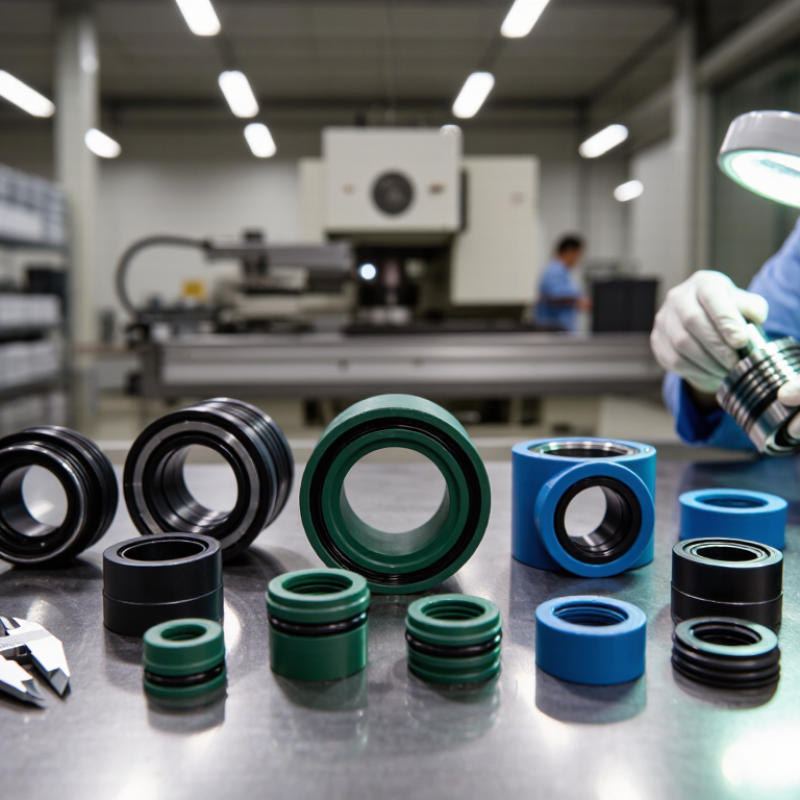
A hydraulic piston seal sits between the piston and cylinder bore. Its main job is to limit fluid bypass between the two sides of the piston. When pressure acts on one side, the seal helps turn that pressure into controlled movement. Without an effective seal, a cylinder may drift, lose force, or move unevenly. That matters.
Piston seals also need to manage friction and tolerate pressure changes, temperature shifts, and repeated motion. The right design depends on the cylinder, fluid, operating pressure, and speed. A seal that works well in a slow, cool application may wear quickly in a hot, fast-moving one. Material choice matters, but so do groove dimensions and surface finish. Small details matter.
During inspection, technicians may look for fluid leakage, scored surfaces, hardening, or uneven wear. These signs can point to seal damage, but they may also reflect contamination, misalignment, or installation problems. Replacing the seal alone may not fix the cause. It is worth checking the piston groove and cylinder bore before fitting a replacement. Even careful selection has limits when operating conditions are poorly recorded. Accurate measurements and clear service notes make it easier to choose a suitable piston seal and assess its performance over time.
| Topic | Role or technical fact | What to consider | What to verify with a manufacturer |
|---|---|---|---|
| Primary function | A piston seal limits fluid leakage between the two sides of a hydraulic cylinder piston, helping the cylinder maintain pressure and deliver force. | The seal must suit the cylinder’s pressure, speed, temperature, fluid, and operating cycle. | Ask for application-specific recommendations rather than selecting by seal material alone. |
| Single-acting piston seal | Designed to seal pressure primarily from one direction; the cylinder’s return movement may be provided by a spring, gravity, or an external load. | Pressure direction and the required sealing behavior during the return stroke. | Confirm the seal profile and installation orientation for the cylinder design. |
| Double-acting piston seal | Designed to seal pressure acting from either side of the piston, allowing powered movement in both directions. | Bidirectional pressure, friction, and the possibility of pressure trapped between sealing elements. | Request guidance on the complete seal arrangement, including any backup or anti-extrusion rings. |
| Common seal profiles | U-cup seals are commonly used for single-acting service; symmetrical profiles and compact assemblies are among the options used for double-acting service. | Profile geometry affects sealing behavior, friction, installation, and resistance to extrusion. | Check profile drawings, groove dimensions, and compatibility with the cylinder’s mating parts. |
| Polyurethane (PU) | Often selected for hydraulic seals because suitable grades can provide good wear and abrasion resistance. | Performance depends on the specific compound and its temperature, fluid, and pressure limits. | Request the compound specification and application limits for the proposed grade. |
| PTFE-based materials | PTFE-based sealing elements are used in some designs where low friction or chemical compatibility is required; some designs use an elastomer energizer. | The complete design and compound determine pressure capability, wear behavior, and compatibility. | Verify the full material construction, not just the name of the base polymer. |
| Operating conditions | Seal performance is affected by pressure, reciprocating speed, temperature, hydraulic fluid, cylinder clearance, and surface finish. | A seal suitable for one cylinder may not be suitable for another with different conditions. | Provide operating data and confirm allowable clearances and surface-finish requirements. |
| Supplier evaluation | A suitable manufacturer should be able to match seal design and material to the application and provide consistent, inspectable products. | Compare technical support, dimensional control, material traceability, sample evaluation, and production consistency. | Request drawings, material data, inspection records, and test evidence relevant to the intended application. |
| Standards and dimensions | ISO 7425-2 covers housing dimensions for elastomer-energized plastic seals used as piston seals in fluid power applications. | A standard dimensional interface does not by itself establish suitability for every operating condition. | Confirm the applicable standard, edition, groove dimensions, and any application-specific deviations. |