
10 Best PLA 3D Printing Filaments for Global Buyers
Choosing the right material can quietly determine whether a 3D print succeeds or fails. For global buyers, Pla 3d Printing filament offers an approachable starting point, but quality varies widely between brands, regions, and production batches.
Josef Průša, founder of Prusa Research, has said, “3D printing is a tool that turns digital ideas into physical objects.” That idea matters when comparing PLA products. A reliable filament should unwind smoothly, maintain a consistent diameter, and produce clean layers without frequent nozzle clogs. Imagine opening a sealed spool and finding crisp edges, even color, and a steady first layer. Small details affect the entire print.
This guide examines ten PLA 3D Printing filaments for international purchasing decisions. It considers dimensional consistency, print temperature, surface finish, spool design, moisture protection, packaging, and printer compatibility. It also looks at practical concerns, including shipping distance, material labeling, recycled content, and value per kilogram. Not every “premium” filament performs better on every machine. That is worth remembering.
PLA prints easily, but it has limits. It can soften in high heat and may not suit demanding outdoor parts. Some buyers may also prefer stronger or more flexible materials. Still, PLA remains useful for prototypes, models, decorations, classroom projects, and everyday components.
The comparison will not pretend to offer one perfect choice. Printer settings, storage conditions, and user experience can change the result. A thoughtful buyer should test before ordering in bulk. Small mistakes happen. Good filament reduces them.
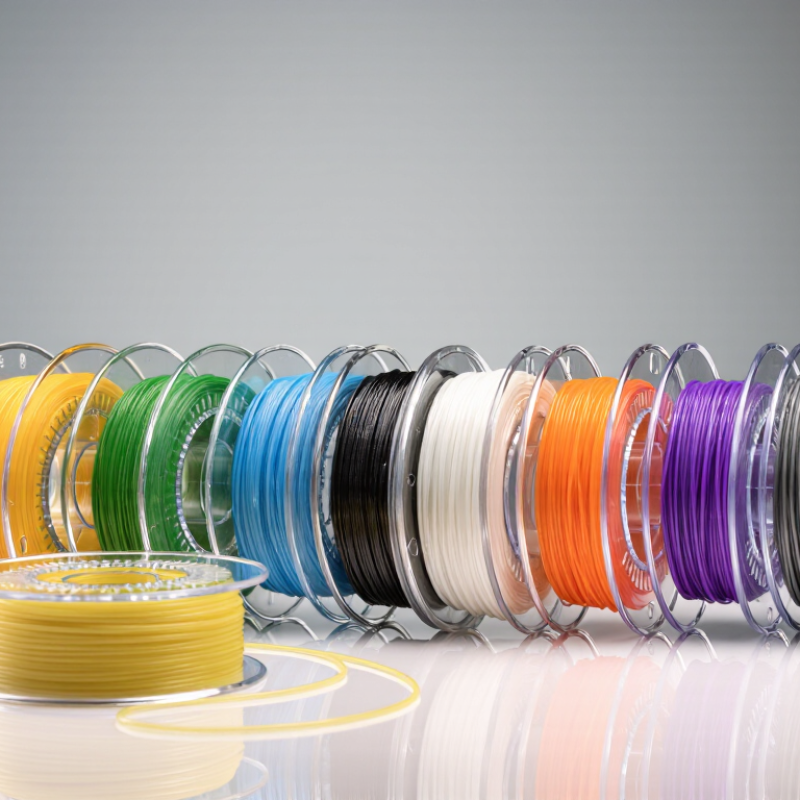
PLA Filament Basics: Composition, Properties, and Common Uses
PLA filament is a thermoplastic polyester commonly produced from fermented plant sugars, including corn and sugarcane. Its renewable feedstock attracts buyers seeking lower fossil-resource dependence. However, “bio-based” does not mean home-compostable. Most PLA requires controlled industrial composting conditions.
PLA usually prints easily because it needs moderate extrusion temperatures and shows limited warping. Its glass-transition temperature is commonly around 55–65°C, while melting behavior often falls near 170–180°C. These values vary with additives and formulation. Printed parts can feel rigid and display sharp surface detail, but they may soften inside a hot vehicle. It is not indestructible. The 2024 Wohlers Report recorded a global additive manufacturing industry value of about 20 billion dollars in 2023, reflecting wider demand for accessible prototyping materials. PLA remains practical for visual prototypes, classroom models, organizers, decorative objects, and low-load fixtures.
Material selection still needs measurement. A buyer should check dimensional tolerance, moisture protection, spool consistency, and published safety documentation. ASTM D638 tensile testing can help compare strength, although test results rarely predict every printed shape. My own purchasing rule would be cautious: a low price means little if the filament contains moisture or varies between batches. That distinction matters. Even reputable technical sheets may simplify real printing conditions. Nozzle size, cooling, layer height, and storage can change the final result. PLA is forgiving, but not foolproof.
10 Best PLA 3D Printing Filaments for Global Buyers - PLA Filament Basics: Composition, Properties, and Common Uses
| Rank | PLA Filament Type | Typical Composition | Nozzle Temperature | Bed Temperature | Typical Density | Typical Tensile Strength | Main Advantages | Common Uses | Important Consideration |
|---|---|---|---|---|---|---|---|---|---|
| 1 | Standard PLA | Polylactic acid, commonly derived from fermented plant sugars | 190–220°C | 0–60°C | About 1.24 g/cm³ | 45–65 MPa | Easy to print, low warping, wide color availability, good surface quality | Prototypes, models, educational projects, decorative parts | Low heat resistance; softening commonly begins near 55–65°C |
| 2 | Tough PLA | PLA modified with impact-resistant polymers or toughening additives | 200–230°C | 0–60°C | About 1.20–1.25 g/cm³ | 40–60 MPa | Higher impact resistance and less brittleness than standard PLA | Functional prototypes, brackets, enclosures, household parts | Formulations differ widely; check the technical data sheet for heat and impact performance |
| 3 | Matte PLA | PLA blended with mineral, polymer, or surface-modifying additives | 195–225°C | 0–60°C | About 1.20–1.30 g/cm³ | 35–60 MPa | Reduces the appearance of layer lines and produces a low-gloss finish | Architectural models, figurines, product mock-ups, display objects | Some matte additives can reduce strength or increase nozzle wear |
| 4 | Silk PLA | PLA containing reflective pigments and appearance-enhancing additives | 200–230°C | 0–60°C | About 1.20–1.28 g/cm³ | 30–55 MPa | Glossy, metallic-looking appearance with strong visual appeal | Art pieces, trophies, ornaments, cosplay details, presentation models | Often weaker and more string-prone than standard PLA; slower printing may improve shine |
| 5 | Wood-Filled PLA | PLA matrix combined with fine wood fibers or wood flour | 190–220°C | 0–60°C | About 1.10–1.30 g/cm³ | 25–45 MPa | Natural wood-like texture, can often be sanded and stained | Decorative objects, terrain models, crafts, architectural prototypes | A 0.4 mm nozzle may clog; a 0.5–0.6 mm nozzle is commonly preferred |
| 6 | Metal-Filled PLA | PLA blended with fine metal powders, such as bronze, copper, or iron | 195–225°C | 0–60°C | About 2.00–3.50 g/cm³ | 20–45 MPa | Heavy, metal-like appearance; can be polished or chemically patinated depending on filler | Sculptures, replicas, jewelry prototypes, historical or industrial models | Highly abrasive; use a hardened nozzle and expect slower flow or increased nozzle wear |
| 7 | Glow-in-the-Dark PLA | PLA containing phosphorescent pigments that store and release light | 195–225°C | 0–60°C | About 1.20–1.30 g/cm³ | 35–55 MPa | Produces a visible glow after exposure to sunlight or strong artificial light | Signs, toys, safety markers, cosplay props, decorative models | Abrasive pigments can damage brass nozzles; glow intensity fades gradually in darkness |
| 8 | Transparent or Natural PLA | PLA with low levels of colored pigment or transparent additives | 195–225°C | 0–60°C | About 1.22–1.25 g/cm³ | 40–60 MPa | Allows light transmission and makes internal features easier to observe | Light diffusers, display models, fluid-path mock-ups, decorative parts | FDM prints are usually translucent rather than optically clear because of layer interfaces |
| 9 | Recycled PLA | PLA produced partly or wholly from reclaimed manufacturing or post-consumer material | 190–225°C | 0–60°C | About 1.20–1.25 g/cm³ | 35–60 MPa | Can reduce dependence on virgin polymer when recycled content is properly controlled | General prototypes, educational prints, low-load household objects | Color consistency and mechanical properties may vary between production batches |
| 10 | Annealing-Grade PLA | PLA formulated to improve crystallization and performance after controlled heat treatment | 200–230°C | 40–60°C | About 1.23–1.27 g/cm³ | 45–70 MPa after suitable annealing | Improved heat resistance and stiffness after a controlled annealing process | Automotive mock-ups, heat-exposed prototypes, functional mechanical parts | Annealing can cause dimensional shrinkage or warping; test critical dimensions before production |