How to Choose a Custom O-Ring Kit Manufacturer?
Choosing a Custom O-Ring Kit Manufacturer is a technical decision, not a simple purchasing task. The right partner must understand pressure, temperature, fluid compatibility, sealing geometry, and installation conditions. A kit may look complete on a workbench, yet fail quickly inside a pump, valve, or hydraulic cylinder.
Roger Boisjoly, the aerospace engineer who investigated the Challenger O-ring failure, warned, “It is my honest and very real fear that if we do not take immediate action to solve the problem.” His words highlight a broader lesson. Small sealing details can create serious operational consequences. Manufacturer selection should therefore begin with evidence, not attractive catalogs or low prices.
This guide examines the practical signals of a capable supplier. It considers compound certification, dimensional control, material traceability, compression testing, packaging quality, and production consistency. It also explores how manufacturers handle drawings, samples, revisions, and urgent replacement needs. Ask difficult questions.
A reliable Custom O-Ring Kit Manufacturer should explain why a specific elastomer fits the application. It should provide clear inspection records and realistic tolerances. Communication matters, especially when a kit includes dozens of sizes and materials. The supplier should also identify risks before production begins.
Some buyers focus too heavily on unit cost. That approach can be misleading. A cheaper kit may increase downtime, leakage, labor, and replacement expenses. Still, no manufacturer is perfect. Specifications may change, documentation may contain gaps, and testing can never represent every field condition. Careful review remains necessary. This outline offers a practical framework for comparing suppliers with greater confidence and fewer costly assumptions.
Define Your Custom O-Ring Kit Requirements
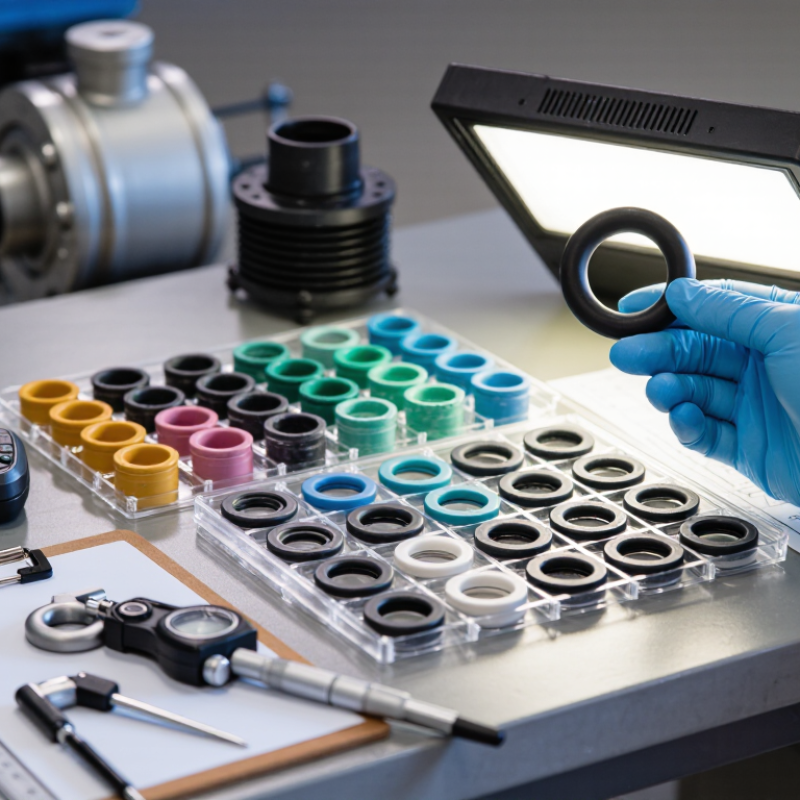
Before choosing a custom O-ring kit manufacturer, define the job each seal must perform. Record the groove dimensions, cord diameter, inside diameter, and required tolerances. A drawing or clear measurement photo can prevent expensive assumptions.
Specify the operating temperature, pressure, motion, and contact media. Hydraulic fluid, cleaning chemicals, outdoor moisture, and dry air can require different elastomers. Ask a qualified engineer to review compatibility data, especially when conditions change during operation.
Hardness matters too. A seal that feels suitable may still deform under pressure. I once saw a kit fail because the material was chosen correctly, but the compression range was ignored.
Clarify quantities, sample needs, packaging, labeling, and delivery expectations. Small batches may need flexible production, while service teams often need organized compartments and clear part identification.
Request material certificates, inspection records, dimensional reports, and lot traceability. These documents reveal whether a manufacturer controls quality or only promises it.
Define acceptance criteria before ordering. Include permitted flash, surface defects, color variation, and replacement procedures.
It is easy to overlook storage life. That mistake becomes costly later. Ask how the kit will be stored and protected from heat, sunlight, ozone, and contamination.
A manufacturer should question unclear requirements instead of accepting every detail without review. Even experienced buyers miss something.
Recheck the specification with maintenance staff who will use the kit in the field.
Evaluate Materials, Standards, and Manufacturing Capabilities
Choosing a custom O-ring kit manufacturer requires more than comparing prices. Start with material evidence. Nitrile suits petroleum oils, while EPDM handles water, steam, and weather better. Fluorocarbon compounds tolerate higher temperatures and aggressive chemicals, but they may lose flexibility in cold conditions. The 2024 Global Rubber Market report by Grand View Research projects steady market growth through 2030, driven partly by demand for engineered sealing products. That growth does not guarantee quality. Ask for compound batch records, temperature ranges, compression-set results, and fluid compatibility data.
Standards reveal manufacturing discipline. ISO 3601 controls O-ring dimensions, tolerances, and inspection methods. ASTM D2000 helps classify rubber performance by heat, oil, and aging resistance. A capable manufacturer should explain which standard applies to your application. Request first-article inspection reports, traceability labels, and measured hardness values. Small dimensional errors can create leaks. I have seen kits fail because storage conditions were ignored, not because the compound was wrong. This is easy to overlook.
Tips: Check whether the manufacturer performs 100% visual inspection. Confirm packaging prevents ozone, sunlight, and deformation. Request samples before approving production. Compare test data with your actual pressure, temperature, and media. A perfect checklist does not exist. Leave room for testing.
How to Choose a Custom O-Ring Kit Manufacturer?
Compare material capability first. The ranges below show typical continuous service-temperature limits for commonly specified elastomers; actual performance depends on compound formulation, fluid compatibility, pressure, and exposure time.
- Materials: confirm compound traceability, hardness options, chemical compatibility, and documented temperature limits.
- Standards: verify dimensional conformity with ISO 3601 or AS568 where applicable; ASTM D2000 can be used to classify rubber compound performance.
- Manufacturing capabilities: review tooling for custom sizes, molding tolerances, flash control, inspection equipment, batch testing, and packaging requirements.
Values are representative engineering ranges in °C and should be validated against the selected compound’s technical data sheet and application conditions.
Verify Quality Control, Testing, and Industry Certifications
When choosing a custom O-ring kit manufacturer, inspect quality control before comparing prices. Ask for material certificates, compound traceability, and batch-level inspection records. Each kit should link its seals to a production lot, cure date, and test result. ISO Survey 2022 recorded more than 1.2 million ISO 9001 certificates worldwide. This scale shows the standard’s reach, not automatic product quality.
Request testing evidence for the actual rubber compound. Useful checks include hardness, tensile strength, elongation, compression set, dimensional accuracy, and leakage performance. ASTM D412 supports tensile testing, while ASTM D395 evaluates compression set. For sealing materials, small test differences matter. A slightly oversized cross-section can create installation damage. A poor compression-set result may cause leakage after prolonged heat exposure.
Review calibration records for gauges, ovens, and test equipment. Also check nonconformance procedures. A reliable manufacturer should explain how failed parts are isolated, investigated, and corrected. Certifications such as ISO 9001, ISO 13485, IATF 16949, or AS9100 may fit different industries. They must match your application. Do not accept a certificate alone. Visit the facility, if possible, and watch how operators label open containers. I have found that simple storage habits often reveal deeper process discipline. One weakness remains easy to miss: suppliers may test samples, but not every production lot. Ask about sampling plans, acceptance limits, and retention of test records before approving the kit.
Compare Customization Options, Pricing, and Production Lead Times
How to Choose a Custom O-Ring Kit Manufacturer?
Customization should begin with application details, not a supplier’s catalog. Define material, hardness, dimensions, tolerances, color, packaging, and operating temperature. ISO 3601 provides widely accepted dimensional and quality guidance for O-rings. ASTM D2000 also helps buyers compare elastomer performance. These standards reduce misunderstandings between drawings and production samples.
Pricing depends on more than unit cost. Tooling, compound selection, inspection, packaging, and minimum order quantities can change the quotation sharply. Mordor Intelligence’s 2024 O-Ring Seals Market analysis estimates continued market growth through 2029, reflecting rising demand across industrial equipment and transportation. That growth may improve sourcing options, but it does not guarantee lower prices. Ask for a cost breakdown. Small details matter.
Production lead time needs practical verification. Request separate schedules for design review, tooling, sampling, testing, and mass production. A simple kit may ship quickly, while unusual materials or tight tolerances require additional validation. In my experience, optimistic estimates often ignore approval delays. Forecasts are not guarantees. Confirm available molding capacity, inspection methods, and buffer stock before placing an order. A manufacturer that explains limitations clearly may be more reliable than one offering the fastest promise.
Assess Supplier Reliability, Support, and Long-Term Partnership Potential
How to Choose a Custom O-Ring Kit Manufacturer? Assess Supplier Reliability, Support, and Long-Term Partnership Potential
A dependable manufacturer should prove consistency before accepting a large custom order. Request material certificates, batch traceability, dimensional inspection records, and documented change-control procedures. For critical applications, ask whether production follows ISO 9001 controls and whether first-article inspection reports are available. The 2023 Deloitte Global Chief Procurement Officer Survey identified supply continuity as a leading procurement priority, with 72% of procurement leaders citing it as a major concern. That finding supports a practical question: can the supplier maintain quality during material shortages or sudden demand changes?
Test the relationship with a small pilot kit. Measure response time, packaging accuracy, label clarity, and handling of nonconforming parts. Good technical support should explain hardness, compound selection, compression set, temperature limits, and chemical compatibility without hiding behind vague claims. Ask for realistic lead times, safety-stock options, tooling ownership terms, and written notification before material or process changes. Small details matter.
Look beyond price. A 2024 industry supply-chain survey from the Hackett Group reported that procurement organizations continue investing in resilience and supplier collaboration. That makes long-term communication a measurable capability, not a friendly promise. I have seen low quotations become expensive after unclear tolerances caused rework. This is easy to overlook. A supplier may pass an initial audit yet struggle with engineering changes six months later. Review quarterly quality data, corrective-action speed, and delivery performance before expanding the partnership.
| Evaluation Category | Assessment Criterion | Recommended Benchmark | Evidence to Request and Verify | Weight | Assessment Status | Score |
|---|---|---|---|---|---|---|
| Reliability | Quality management system | Documented quality procedures, controlled production records, and a current third-party certification where applicable. | Quality certificate, audit report, inspection plan, nonconformance procedure, and corrective-action records. | 15% | Required | 5/5 |
| Reliability | Material and batch traceability | Each O-ring kit should be traceable to compound, cure batch, inspection results, packaging date, and shipment documentation. | Batch certificates, material declarations, lot-number format, retention policy, and sample traceability record. | 12% | Required | 5/5 |
| Reliability | Dimensional and visual inspection | Inspection should address inside diameter, cross-section, flash, surface defects, compression set requirements, and kit quantity. | Control plan, calibrated measurement equipment list, sampling method, inspection report, and retained samples. | 12% | Required | 5/5 |
| Reliability | Delivery performance | Target an on-time-in-full delivery rate of at least 95% over a rolling six- to twelve-month period. | Order history, confirmed-versus-actual shipment dates, backlog report, and explanation of late deliveries. | 10% | Preferred | 4/5 |
| Customization | Material selection capability | Ability to recommend suitable elastomers based on temperature, fluid exposure, pressure, hardness, regulatory, and application requirements. | Material compatibility guidance, compound data sheets, temperature limits, hardness options, and compliance declarations. | 10% | Required | 5/5 |
| Customization | Kit configuration flexibility | Support for mixed sizes, multiple materials, color coding, labeled compartments, custom quantities, and application-specific packaging. | Packaging drawings, sample kit, labeling specifications, minimum order quantities, and change-control procedure. | 8% | Preferred | 5/5 |
| Support | Technical response time | Initial technical questions acknowledged within one business day, with a complete response normally provided within three business days. | Service-level commitment, technical contact details, sample email response, and escalation process. | 8% | Preferred | 4/5 |
| Support | Application engineering support | Supplier can review drawings, sealing conditions, installation risks, tolerance stack-up, and material compatibility before production. | Design-review checklist, engineering questionnaire, application case summaries, and approval workflow. | 8% | Preferred | 5/5 |
| Commercial | Quotation transparency | Quotation clearly separates tooling, samples, testing, packaging, freight, taxes, minimum order quantities, and recurring unit costs. | Detailed quotation, validity period, payment terms, tooling ownership terms, and cost-change conditions. | 5% | Required | 5/5 |
| Partnership | Capacity and supply continuity | Documented capacity plan, qualified backup processes, safety-stock options, and a practical business-continuity plan. | Capacity statement, production schedule, contingency plan, alternate material or process approval, and inventory policy. | 6% | Review | 4/5 |
| Partnership | Corrective action and communication | Quality issues should receive documented containment, root-cause analysis, corrective action, and closure verification. | Anonymous corrective-action example, response-time target, complaint log format, and management escalation route. | 6% | Required | 5/5 |
| Suggested interpretation: prioritize documented evidence over quoted claims and reassess performance after pilot orders. | 100% | Weighted Result | 4.7/5 | |||