
2026 How to Choose High End Speed Gate KZ FT069S?
Choosing a High-end speed gate KZ-FT069S in 2026 requires more than comparing prices or appearance. A premium entrance system should match the building’s traffic, security policy, and daily operating habits. Consider office lobbies, airports, hospitals, campuses, and luxury residential entrances separately. Each location creates different demands.
Access-control specialist Michael Chen says, “The best speed gate is not the fastest model; it is the one people can use safely every day.” This practical view matters. A busy lobby may need rapid passage, quiet operation, and reliable anti-tailgating detection. A hospital may require wider access, wheelchair-friendly movement, and simple emergency release. Check lane width, sensor accuracy, motor response, glass-panel visibility, and integration with cards, QR codes, biometrics, or visitor systems.
Look closely at construction details. A solid stainless-steel frame, clean glass edges, and consistent panel movement can reveal manufacturing quality. Ask about ingress protection, standby power, firmware updates, spare parts, and local service response. These details feel minor during installation. They become important after thousands of daily cycles.
Do not choose only from a brochure. Request a live demonstration with realistic traffic. Watch how the gate reacts when someone follows closely, pauses midway, or approaches from the wrong direction. The result may expose weaknesses.
A high-end product can still be unsuitable. Installation space, user behavior, and maintenance discipline may reduce its real value. This guide examines the High-end speed gate KZ-FT069S through performance, safety, integration, durability, and total ownership cost. Some conclusions may remain imperfect, because every site behaves differently.
What Defines a High-End Speed Gate KZ FT069S?
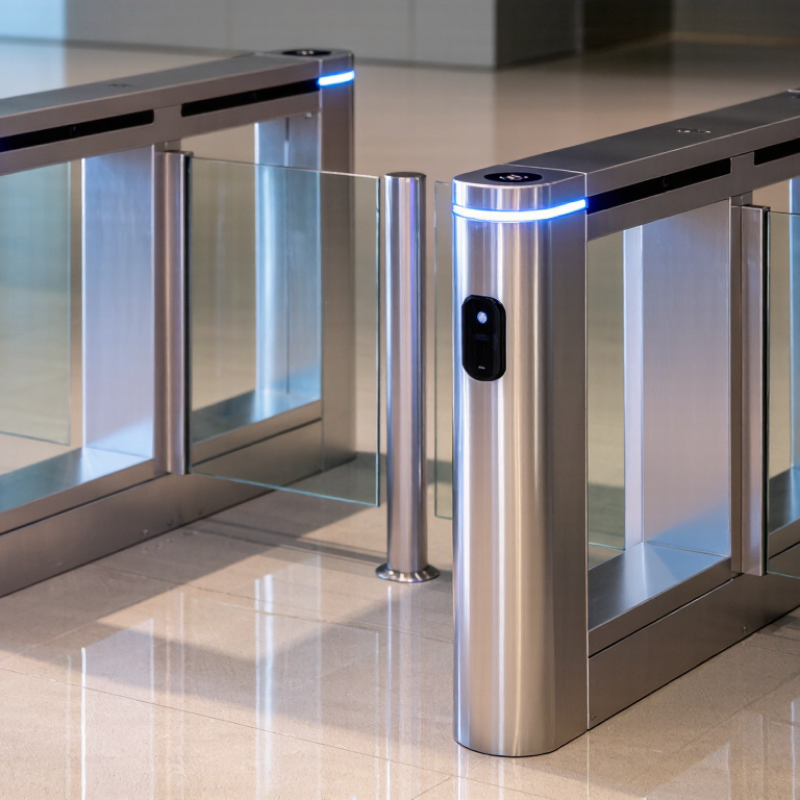
A high-end speed gate is defined by more than a polished stainless-steel body. It should combine stable access control, smooth movement, and dependable safety sensing. Look for a brushless motor, accurate infrared sensors, and a reinforced barrier mechanism. The gate should open quickly without striking or vibrating. Quiet operation also matters in offices, hotels, and transport facilities.
I would test the gate during busy periods, not only in a showroom. Check whether sensors respond reliably to children, luggage, and people walking closely together. Review access records, emergency release functions, and integration with cards, QR codes, or biometric systems. A useful evaluation also includes cycle testing, maintenance access, and clear fault signals. Certification documents and a written warranty improve reliability, but they should support real testing, not replace it. A perfect appearance proves little.
Tips: Measure the lane width before ordering. Confirm power requirements and standby consumption. Ask for noise data and cycle-test results. Inspect the hinge area and sensor windows for easy cleaning. Watch the gate during repeated passages. Small delays can become frustrating at peak hours. I may overlook installation conditions sometimes, especially floor unevenness and nearby lighting. That is why a site trial remains important. Good engineering is visible in quiet movement, consistent detection, and simple maintenance.
2026 How to Choose High End Speed Gate KZ FT069S? - What Defines a High-End Speed Gate KZ FT069S?
| Evaluation Dimension | High-End Reference Standard | Why It Matters | Recommended Verification Method |
|---|---|---|---|
| Passenger Throughput | Approximately 25–60 persons per minute per lane, depending on access-control speed and user behavior. | Helps reduce queues in offices, transport facilities, stadiums, and other high-traffic buildings. | Request a live throughput test using the intended credential system and lane configuration. |
| Opening and Closing Response | Smooth motorized movement with typical access-response times below 1 second when the controller and reader are properly configured. | Fast response improves user flow while reducing hesitation and tailgating opportunities. | Measure the complete cycle from credential authorization to gate opening and secure reclosing. |
| Safety Detection | Multi-zone presence and obstruction detection, with automatic stop or reverse protection during movement. | Protects users, luggage, mobility aids, and the gate mechanism. | Test with a suitable obstruction object and confirm that the gate reacts without excessive force. |
| Emergency Egress | Automatic unlocking or opening during a fire alarm, emergency signal, power failure, or approved evacuation command. | Supports safe evacuation and integration with the building fire and life-safety system. | Conduct a documented emergency test with the fire-alarm, access-control, and backup-power systems. |
| Accessibility | At least one accessible lane designed for wheelchair users, mobility scooters, luggage, and users with reduced mobility. | Improves inclusive access and helps satisfy local accessibility requirements. | Confirm the clear passage width, approach space, sensor behavior, and accessible-control placement against local regulations. |
| Construction Materials | Corrosion-resistant stainless steel, commonly grade 304 for indoor environments and grade 316 where higher corrosion resistance is required. | Material quality affects appearance, durability, cleaning, and resistance to corrosion. | Check material certificates, surface finish, weld quality, edge treatment, and resistance to cleaning chemicals. |
| Glass Safety | Safety glass, such as tempered or laminated glass, with polished edges and secure mechanical mounting. | Reduces injury risk and improves resistance to impact during daily operation. | Request the glass specification and inspect edge finishing, mounting hardware, and impact-protection design. |
| Access-Control Compatibility | Support for common dry-contact, relay, Wiegand, networked, QR-code, RFID, biometric, and ticketing interfaces, as applicable. | Allows the gate to work with existing or planned security infrastructure. | Verify wiring diagrams, communication protocols, input/output timing, and integration documentation. |
| Tailgating and Anti-Passback | Bidirectional sensors or integration with the access-control platform to identify multiple users passing on one authorization. | Strengthens security at restricted entrances and reduces unauthorized passage. | Test single-person authorization, close-following, reverse passage, and simultaneous entry attempts. |
| Reliability and Service Life | A documented duty-cycle rating, replaceable drive components, fault logging, and a maintenance plan suited to the expected traffic level. | Reduces downtime and makes long-term operating costs more predictable. | Review endurance-test records, preventive-maintenance intervals, spare-parts availability, and service response times. |
| Power-Failure Operation | Defined fail-safe or fail-secure behavior, with optional battery backup or connection to an uninterruptible power supply. | Maintains security and controlled passage during short power interruptions. | Disconnect normal power and confirm gate behavior, alarm reporting, and recovery after power restoration. |
| Noise and User Comfort | Low-vibration drive movement, controlled acceleration and deceleration, and minimal operating noise for indoor environments. | Creates a premium user experience and reduces disturbance in reception areas and offices. | Evaluate sound, vibration, movement smoothness, and closing force during repeated operation. |
| Environmental Protection | An enclosure rating appropriate to the installation location; indoor and outdoor requirements should be specified separately. | Helps protect electronics and mechanical parts from dust, moisture, and cleaning procedures. | Confirm the declared IP rating and installation limits, then inspect cable entries, seals, and drainage design. |
| Compliance and Documentation | Complete installation, wiring, risk-assessment, maintenance, and emergency-operation documentation; applicable standards depend on the project location. | Clear documentation simplifies approval, commissioning, maintenance, and operator training. | Request declarations, test reports, manuals, drawings, risk assessments, and local compliance evidence before purchase. |
Note: The figures above are general industry reference ranges for evaluating a high-end speed gate. Final performance depends on the lane layout, access-control system, installation conditions, traffic profile, and applicable local regulations.