
Top 10 Insulated Floor Tile Panels for Global Buyers
Choosing the right Insulated Floor Tile Panels is more complex than comparing prices and surface finishes. Global buyers must examine thermal resistance, moisture control, compressive strength, fire performance, installation methods, and regional climate demands. A panel that performs well in a dry warehouse may fail in a humid coastal project.
Dr. Joseph Lstiburek, a respected building-science expert, often reminds professionals, “There is no such thing as a perfect building.” His observation also applies to flooring systems. Every product involves trade-offs between insulation value, thickness, durability, weight, and installation speed. Buyers should study technical datasheets, independent test reports, warranty terms, and supplier experience before making a decision.
This guide reviews ten Insulated Floor Tile Panels for international purchasing teams, contractors, architects, and distributors. The comparison considers practical details, including panel edges, tile compatibility, vapor resistance, load support, cutting accuracy, and replacement convenience. Imagine a cold storage corridor, a residential renovation, or a temporary commercial floor. Each setting creates different performance pressures.
Small details matter.
Some panels may look impressive but lack clear test information. Others may offer strong insulation yet require specialized installation tools. That weakness deserves attention. Product rankings should not replace project-specific engineering or local compliance checks. They should support better questions, clearer comparisons, and more confident procurement decisions across different markets.
What Are Insulated Floor Tile Panels?
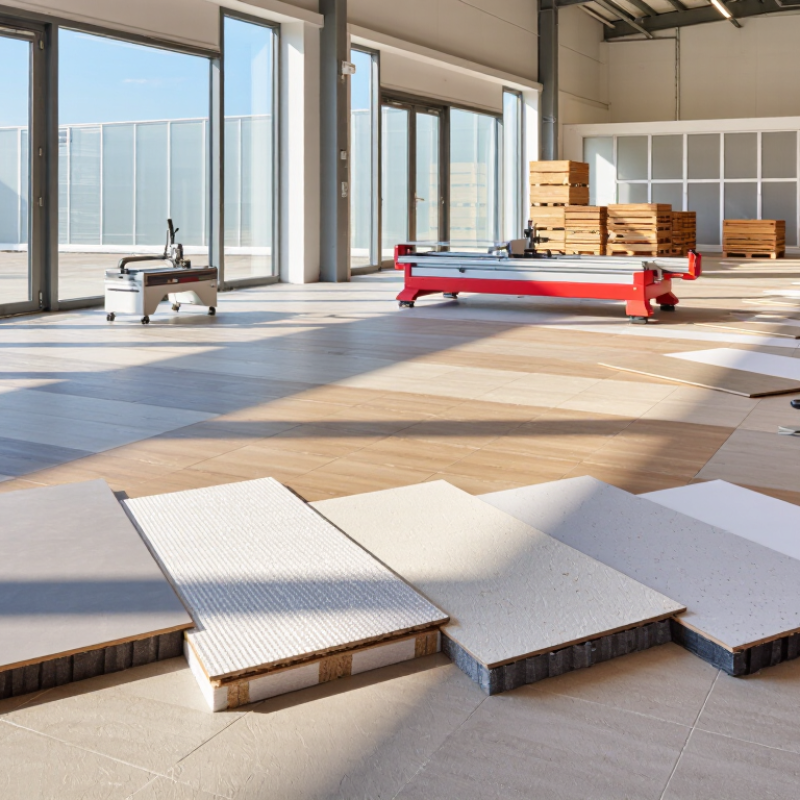
Insulated floor tile panels are engineered boards that combine thermal insulation with a firm, tile-ready surface. They usually contain a rigid foam or mineral-based core, covered by cementitious, fiber-reinforced, or waterproof facing layers. Ceramic, porcelain, or stone tiles can then be installed above them with suitable adhesive.
The term is not perfectly standardized. Some suppliers mean tile backer boards, while others mean structural floor panels with insulation included. Buyers should check compressive strength, moisture resistance, thermal conductivity, thickness, and tested load capacity. A panel may feel solid but still perform poorly under heavy furniture or uneven subfloors. That detail is easy to miss.
The International Energy Agency and UNEP reported that buildings and construction consumed about 30% of global final energy in 2022. They also produced approximately 26% of energy-related emissions. Proper floor insulation can reduce heat transfer through cold slabs, suspended floors, and rooms above unheated spaces. However, results depend on installation quality, perimeter sealing, and local climate.
Look beneath the tile system.
For global buyers comparing the top ten options, test documentation matters more than attractive product claims. Look for data based on recognized standards, including thermal resistance, water absorption, fire performance, and dimensional stability. The U.S. Department of Energy also emphasizes continuous insulation and careful air sealing in efficient building assemblies. Real projects remain imperfect. Small gaps, damp substrates, or incorrect adhesive selection can undermine an otherwise advanced panel.
| Rank | Panel Type | Typical Core Material | Common Tile-Facing or Substrate | Typical Thickness | Typical Thermal Conductivity (λ, W/m·K) | Approx. Thermal Resistance at 20 mm (R, m²·K/W) | Typical Compressive Strength | Moisture Performance | Typical Global Applications |
|---|---|---|---|---|---|---|---|---|---|
| 1 | Cement-Faced XPS Tile Backer Panel | Extruded polystyrene foam | Polymer-modified cement or glass-fiber-reinforced cement surface | 6–80 mm | 0.029–0.036 | 0.56–0.69 | 200–500 kPa | Closed-cell core; low water absorption when joints and penetrations are sealed | Bathrooms, kitchens, wet rooms, balconies, and underfloor heating systems |
| 2 | Glass-Fiber-Faced EPS Tile Panel | Expanded polystyrene foam | Glass-fiber mesh with cementitious coating | 10–60 mm | 0.031–0.040 | 0.50–0.65 | 100–250 kPa | Resistant to rot; requires a continuous waterproofing system in wet areas | Residential floors, lightweight renovation, and projects requiring low panel weight |
| 3 | PIR Insulation Tile Backer Panel | Polyisocyanurate rigid foam | Aluminium foil, glass-fiber, or cementitious facing | 20–120 mm | 0.022–0.028 | 0.71–0.91 | 120–200 kPa | Low water absorption; edge detailing and compatible adhesive are required | Thin-build floors, energy-efficient renovations, and cold-climate construction |
| 4 | Phenolic Foam Tile Support Panel | Rigid phenolic foam | Mineral-coated glass-fiber or foil laminate facing | 20–100 mm | 0.020–0.025 | 0.80–1.00 | 90–150 kPa | Generally low water absorption; all exposed edges should be protected | Projects requiring high insulation performance at restricted floor build-up |
| 5 | Rigid Mineral Wool Tile Panel | High-density stone wool or glass wool | Cementitious board, mineral coating, or rigid reinforced facing | 20–100 mm | 0.034–0.040 | 0.50–0.59 | 40–150 kPa | Non-combustible mineral core; must be kept dry during installation | Fire-conscious buildings, acoustic floor assemblies, and commercial interiors |
| 6 | Cork Composite Tile Underlay Panel | Expanded natural cork granules bonded into rigid board | Raw cork, wood-fiber, or cement-faced surface | 10–40 mm | 0.037–0.045 | 0.44–0.54 | 100–180 kPa | Moderate moisture tolerance; requires dry installation and moisture control below | Residential floors, acoustic improvement, and projects using bio-based materials |
| 7 | Rigid Wood-Fiber Tile Panel | Compressed wood fibers with hydrophobic treatment | Wood-fiber surface or reinforced cementitious facing | 20–80 mm | 0.038–0.050 | 0.40–0.53 | 80–200 kPa | Moisture-sensitive compared with closed-cell foam; requires careful vapor and water control | Low-energy buildings, timber structures, and bio-based construction systems |
| 8 | Aerogel-Enhanced Floor Insulation Panel | Silica aerogel composite or aerogel blanket laminate | Fiber-reinforced mineral, glass-fiber, or cementitious facing | 5–30 mm | 0.015–0.025 | 0.80–1.33 | Application-dependent; commonly requires a load-spreading board | Low moisture uptake; joints and facing must be protected from abrasion and water | Heritage renovation, narrow thresholds, and ultra-thin insulation upgrades |
| 9 | Foam Glass Tile Insulation Board | Cellular glass made from foamed recycled glass | Factory-finished cellular glass or bitumen-coated surface | 30–120 mm | 0.040–0.055 | 0.36–0.50 | 400–1,600 kPa | Closed-cell, non-absorbent, and resistant to rot and most common pests | Basements, ground-bearing floors, high-load areas, and moisture-prone locations |
| 10 | Cement-Bonded Wood-Wool Insulation Panel | Wood wool strands bonded with cement | Mineral or cementitious surface suitable for a separate tile substrate | 15–75 mm | 0.065–0.090 | 0.22–0.31 | 150–500 kPa | More moisture-tolerant than untreated wood fiber; not a waterproofing layer | Acoustic floor systems, service floors, and assemblies requiring mechanical fixing |
| Buyer note: The figures above are representative ranges for generic panel constructions, not product guarantees. Actual performance depends on density, facing, thickness, joints, installation method, temperature, and applicable national standards. Buyers should verify declared thermal conductivity, compressive strength, water absorption, reaction-to-fire classification, tile adhesive compatibility, and testing documentation before purchase. Thermal resistance values are calculated approximately from 0.020 m ÷ λ and exclude facings, adhesive layers, joints, and thermal bridges. | |||||||||