
2026 Top Sprinkler Irrigation Controllers for Global Buyers
Choosing the right Sprinkler Irrigation Controller in 2026 requires more than comparing prices and screen designs. Global buyers must consider water pressure, power supply, climate, field size, and local installation practices. A controller that performs well in a California orchard may struggle in a small greenhouse in Kenya or a windy farm in Australia.
This guide examines leading models through practical criteria, including scheduling accuracy, weather-based adjustment, sensor compatibility, remote access, durability, and service support. It also considers installation details that product pages often overlook. Clear terminals matter. So does a strong enclosure. A bright display can help technicians work beside wet valve boxes, while reliable connectivity supports farms far from urban networks.
Real-world experience remains important. Testing should include seasonal changes, unstable internet connections, and unexpected rain. Some controllers appear intelligent but still require careful programming. Others offer impressive apps yet provide limited local support. That matters. Buyers should verify warranty terms, software availability, replacement parts, and regional voltage requirements before ordering.
The models discussed here are not ranked by marketing claims alone. Their strengths and weaknesses deserve equal attention. No controller fits every landscape. That is easy to forget. A smaller, simpler system may outperform a feature-heavy model when maintenance resources are limited. This review aims to help distributors, growers, contractors, and property managers make dependable choices for 2026, while recognizing that field conditions can expose flaws no brochure predicts.
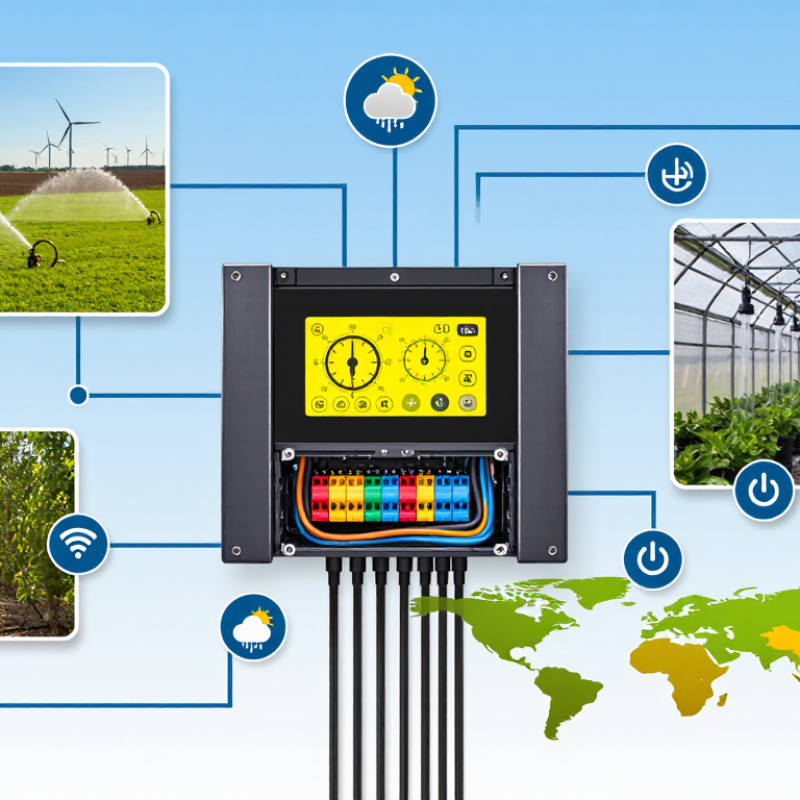
Smart Irrigation Controllers: ET, Soil-Moisture, Rain and Flow Inputs
Smart irrigation controllers are becoming practical water-management tools, not decorative automation. FAO AQUASTAT reports that agriculture uses about 70% of global freshwater withdrawals. For global buyers, ET inputs are valuable because they estimate crop water loss from weather, temperature, wind, and solar radiation. Soil-moisture sensors add a direct check near the root zone. These systems can disagree. That is normal.
Rain sensors should pause scheduled irrigation after measurable rainfall, while flow sensors detect broken pipes, blocked filters, or unusual consumption. The U.S. EPA WaterSense program reports that weather-based irrigation controllers can reduce landscape water use by up to 15% when correctly installed and programmed. Field commissioning often shows a harder truth: poor sensor placement can erase those gains. A sensor under a roof gives misleadingly dry readings. A shallow probe may miss deeper root moisture.
Tips: Match sensor depth to the crop’s active roots. Test flow alerts with a controlled leak simulation. Review ET settings after seasonal weather changes. Keep manual inspection in the schedule. Software cannot see every clogged nozzle.
A reliable controller should accept several inputs, record events, and allow local adjustment when internet service fails. Rain alone is not enough for sloped sites or sandy soil. Flow data also needs a baseline from normal watering cycles. Buyers should request calibration procedures, replacement-sensor availability, and clear data export terms. The perfect setting rarely exists. Real landscapes change.
| Controller Category | Recommended Application | Typical Station Capacity | Core Sensor Inputs | Weather and ET Functions | Soil-Moisture Management | Flow Monitoring | Connectivity | Power Options | Typical Enclosure Rating | Best-Fit Buyer Profile |
|---|---|---|---|---|---|---|---|---|---|---|
| Premium Cloud-Managed Smart Controller | Large residential properties, commercial landscapes, hotels, campuses and multi-site facilities | 12–48 stations; expandable architecture available | Rain sensor, flow meter, soil-moisture sensor, temperature sensor and pressure-switch input | Automatic weather adjustment, reference ET scheduling, seasonal water-budget control and forecast-based skip days | Adjusts or suspends irrigation when measured root-zone moisture reaches a defined threshold | Real-time flow alerts, leak detection, high-flow and low-flow alarms | Wi-Fi, cellular or Ethernet; browser and mobile-app access | 24 VAC transformer; battery backup commonly used for memory and clock retention | Indoor cabinet or outdoor enclosure rated up to IP65, depending on configuration | Global buyers needing remote management, centralized reporting and water-use accountability |
| ET-Based Commercial Controller | Municipal parks, sports fields, golf-course zones and public landscape projects | 24–96 stations through modular expansion | On-site weather station, rain sensor, temperature, wind, solar-radiation and humidity inputs | Uses reference evapotranspiration and crop or landscape coefficients to calculate irrigation runtimes | Optional soil-moisture feedback for runtime correction and irrigation lockout | Flow sensing by master valve, pulse-output meter or digital flow sensor | Cellular, Ethernet, radio or local field-bus connection | 24 VAC control output; surge protection and backup power recommended | Outdoor cabinet commonly specified at IP54–IP66 according to installation conditions | Professional operators managing large areas with variable climate and irrigation demand |
| Soil-Moisture Feedback Controller | Water-sensitive landscapes, sandy soils, tree zones, nurseries and high-value planting areas | 4–24 stations | Capacitance, frequency-domain or tensiometer-type soil-moisture sensors; rain input optional | Can combine programmed schedules with weather-based seasonal adjustment | Starts, shortens or skips irrigation according to measured volumetric water content or soil-water tension | Optional master-valve and flow-meter monitoring | Wired sensor network, LoRaWAN, Bluetooth commissioning or cellular gateway | 24 VAC mains supply; solar power may be used for remote sensor nodes | Outdoor controller commonly specified at IP55 or higher | Buyers prioritizing root-zone control, reduced runoff and protection against overwatering |
| Rain- and Flow-Safety Controller | Residential irrigation, retail sites, offices and small commercial landscapes | 4–16 stations | Rain shutoff sensor, master-valve output and flow-meter input | Seasonal adjustment and rain-delay functions; full ET capability depends on the connected service | Usually not included; may support a single moisture sensor through an auxiliary input | Detects no-flow, low-flow and excessive-flow conditions to limit water loss | Wi-Fi, cellular or local programming interface | 24 VAC transformer with optional surge protection | Indoor or weather-resistant outdoor housing; verify the stated IP or NEMA rating | Buyers seeking practical water conservation and basic fault protection at moderate cost |
| Solar-Powered Remote-Area Controller | Farms, roadside planting, remote gardens, temporary sites and locations without grid electricity | 1–16 stations; normally designed for low-voltage latching solenoids | Rain, soil-moisture, tank-level, pressure and flow inputs, depending on the model | Weather adjustment may be provided through a cellular or satellite-connected gateway | Supports threshold-based irrigation using local soil-moisture readings | Optional pulse flow meter and pump-status input | Cellular, LoRaWAN, satellite or local Bluetooth configuration | Solar panel with rechargeable battery; system sizing depends on valve count and communications load | Outdoor housing commonly rated IP65 or higher for exposed installations | Global buyers requiring autonomous operation where grid power and wired communications are limited |
| Pump-and-Fertigation Irrigation Controller | Greenhouses, nurseries, agricultural blocks and pressurized drip or sprinkler systems | 8–64 irrigation zones with pump, valve and dosing outputs | Flow, pressure, tank level, conductivity, pH, rain and soil-moisture inputs | Can apply weather or ET adjustments to scheduled irrigation cycles | Uses moisture thresholds to initiate irrigation or modify cycle duration | Monitors mainline flow, zone flow and pump performance; supports alarm shutdown | Industrial Ethernet, RS-485, cellular or supervisory-control integration | 24 VAC outputs with separate pump-control circuits; 100–240 VAC supply is common at the cabinet | Industrial outdoor cabinet commonly specified at IP65 or higher | Buyers needing coordinated control of valves, pumps, filters and nutrient-injection equipment |
| Modular Field-Bus Controller | Large landscapes, distributed parks, campuses and projects with long cable distances | 32–256 stations through remote two-wire or field-bus modules | Rain, flow, pressure, soil-moisture and pump-status inputs through local interface modules | Supports seasonal adjustment; ET functions are commonly supplied by a central platform | Zone-level moisture feedback is available when compatible sensor modules are installed | Centralized flow monitoring with station-level alarm reporting | Two-wire field bus, RS-485, Ethernet, cellular or radio communication | 24 VAC controller supply; field modules may use two-wire communication and local power conditioning | Controller and field enclosures commonly rated IP54–IP66 | Project buyers seeking reduced trenching, scalable expansion and centralized maintenance |
| Residential Wi-Fi Smart Controller | Homes, small gardens, rooftop landscapes and low-complexity sprinkler systems | 4–16 stations | Rain sensor and flow input; soil-moisture input is optional on selected configurations | App-based weather adjustment, rain delay and seasonal percentage control | Limited or optional sensor-based control; schedule-based operation remains common | Optional flow meter for leak and broken-pipe alerts | 2.4 GHz Wi-Fi is common; Bluetooth is often used for initial setup | 24 VAC plug-in transformer | Indoor installation or weather-resistant enclosure; outdoor rating must be verified before mounting | Household and small-site buyers wanting simple mobile control and low installation complexity |