
Why Choose a Playground Set for Your Backyard?
A backyard can be more than a patch of grass. With a thoughtfully chosen Playground Set, it can become a place for climbing, swinging, and imaginative play close to home. Children might turn a simple platform into a lookout tower, then spend the afternoon inventing its story. Those ordinary moments matter. They offer room to move and play without planning a trip or packing the car.
Still, a play structure is not a shortcut to happy afternoons. The right choice depends on children’s ages, available space, and the time adults can give to supervision and upkeep. A compact swing-and-slide set may suit a small yard; a larger structure can feel crowded if there is little room around it. Measure the area, check the manufacturer’s age guidance, and follow installation and surfacing instructions. These practical details are easy to overlook. They matter more than an impressive photo online.
A backyard set can also create a gentle routine: a few minutes outside after school, or a place to gather on a weekend. But children’s interests change, and wood, hardware, and moving parts need regular attention. No set stays perfect forever. Choosing carefully means weighing the fun against the upkeep, then making space for play that fits your family and yard.
What a Backyard Playground Set Includes
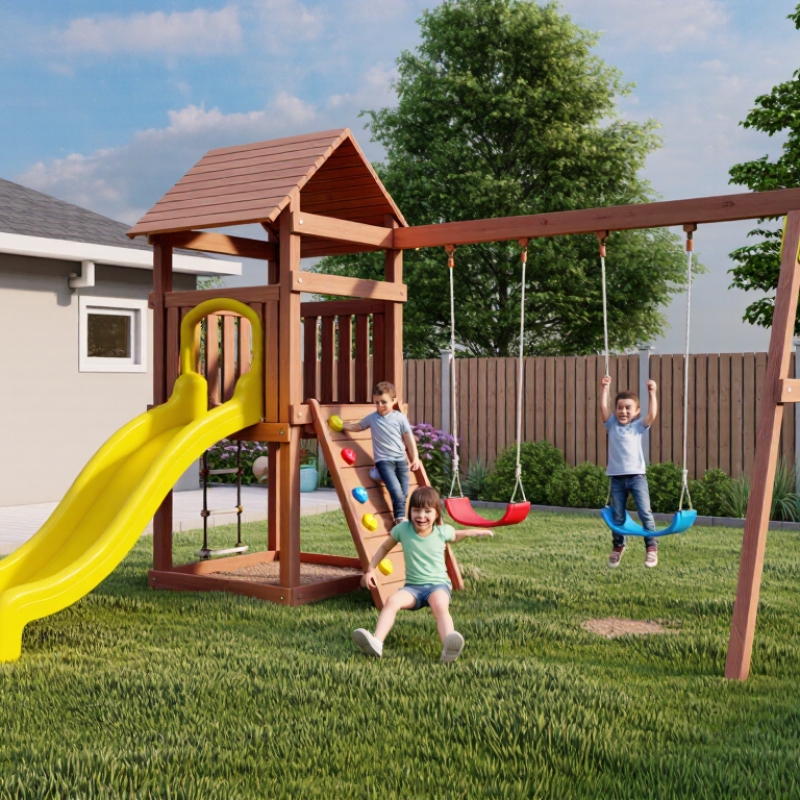
A backyard playground set usually combines a raised platform with ways to climb up and play. The platform may have a roof, partial walls, or open sides. A ladder or steps provide access, while guardrails help protect children on elevated areas. Details vary, so check the listed age range and weight limits before choosing.
Many sets add a slide, swings, or a climbing feature such as a rope or angled wall. Some include a steering wheel, telescope, or small play panel beneath the platform. These extras can encourage imaginative play, but they also need enough clear space around them. A swing, for example, needs room to move without striking a fence or tree. Small details matter.
The package may also include connectors, bolts, and assembly instructions, but ground preparation is often a separate task. Level soil, suitable anchoring, and impact-absorbing surfacing can affect how safely the set is used. Follow the maker’s installation and inspection guidance, and check hardware periodically for looseness or wear. It is easy to focus on the slide. Less exciting, but important: confirm that adults can see the play area clearly from the house or yard.
How Play Sets Support Children’s Physical and Social Development
A backyard play set can turn a patch of grass into an invitation to move. Children climb, balance, swing, and repeat the same route until it feels easy. The World Health Organization’s 2020 guidelines recommend an average of at least 60 minutes of moderate-to-vigorous activity daily for children ages 5–17. A 2019 study in The Lancet Child & Adolescent Health estimated that 81% of adolescents worldwide did not meet that benchmark. A play set cannot close the gap alone, but having active play close to home may make movement easier to fit into ordinary days. Small moments count.
Play also gives children chances to practice being together. Waiting for a turn, agreeing on a game, or deciding who gets the top platform can build communication and cooperation. The American Academy of Pediatrics’ 2018 clinical report, “The Power of Play,” describes play as supporting social-emotional skills, language, and executive function. The lessons can be uneven. A disagreement over whose turn it is may need an adult’s calm help, and some afternoons the equipment may sit unused. That is normal. Keep the landing area clear, supervise play, and let children invent their own games when it is safe to do so.
Choosing Features for Children’s Ages and Abilities
A playground set should fit the children who will use it now, not just look exciting in a catalog. For toddlers, choose low platforms, wide steps, sturdy handholds, and a short slide with a gentle exit. Small details matter. A child who can climb one step confidently may still need help getting down. Follow the set’s age and weight guidance, and check that the landing area is clear and soft enough for its design.
Older children may enjoy taller climbing features, overhead bars, or swings that allow more movement. But age alone is a rough guide. Consider balance, reach, confidence, and how a child handles waiting or sharing space. For children with limited mobility, look for routes with fewer barriers, stable transfer points, and room for an adult to assist. Keep it simple. A feature that is technically accessible may still be difficult to use without support.
Think about how abilities might change over the next few years. Adjustable swing seats or a mix of easy and challenging activities can extend the set’s usefulness. Still, buying for a future version of your child can leave today’s play feeling frustrating. That trade-off is worth considering. Check fasteners and surfaces regularly, and supervise play according to children’s needs and the equipment instructions.
Assessing Yard Space, Materials, and Safety
A playground set works best when it fits the yard around it. Measure the play area, then mark the proposed footprint with stakes or a garden hose. Leave room for swings to travel and children to move around entrances. A small lawn can look roomy until the slide and swing arcs are mapped. Measure twice. Check slopes, roots, drainage, and nearby fences; wet ground can turn a convenient corner into a maintenance problem.
Materials shape upkeep as much as appearance. Durable wood can feel sturdy, but it needs regular checks for splinters, loose fasteners, and weather wear. Metal parts may need inspection for rust and hot surfaces in direct sun. Plastic components are easier to wipe clean, though cracks and fading still matter. Read the assembly and care instructions, and consider your local climate. I might be overcautious, but “low maintenance” rarely means no maintenance.
Safety deserves more than a quick glance at the frame. Choose level, stable ground and use the specified anchors. Keep the recommended clear space around each feature, especially swings and slides. Use an impact-absorbing surface suited to the set’s height, and check its depth as loose fill shifts. Inspect bolts, ropes, and platforms before play, and involve an adult in setup and routine checks. No setup is perfect. A monthly walk-around can catch small problems before they become urgent.
| Assessment Area | Planning Information | What to Check | Practical Takeaway |
|---|---|---|---|
| Available yard space | A compact play set might have an equipment footprint of about 8 × 8 ft; a larger set may be around 12 × 12 ft. These are planning examples, not standard product dimensions. | Measure the level, usable area and note fences, trees, walls, overhead branches, and utility lines. | Compare the complete play area—not just the equipment footprint—with the space available. |
| Clearance around equipment | As a general planning guideline, allow at least 6 ft of clear space around many residential play structures. A footprint of 8 × 8 ft would therefore need roughly 20 × 20 ft; a 12 × 12 ft footprint would need roughly 24 × 24 ft. | Clearance requirements vary by equipment type and layout. Follow the play-set instructions and applicable safety guidance. | Slides, climbing features, and nearby obstacles may require additional consideration beyond a simple perimeter estimate. |
| Swing clearance | Swing travel needs extra room in front of and behind the seats. CPSC guidance recommends extending protective surfacing in those directions to a distance twice the height of the pivot point. | Measure from the swing’s pivot point and keep the travel area free of fences, trees, walls, and walkways. | A swing set can need substantially more yard depth than its frame alone suggests. |
| Wood construction | Wooden sets are commonly made with treated or naturally durable lumber. Exposure to weather can lead to fading, checking, or splinters over time. | Check the care instructions, hardware, finish, and wood condition regularly. Avoid wood treatments that are not intended for play equipment. | Wood can suit a natural-looking yard, but it needs ongoing inspection and maintenance. |
| Metal construction | Metal frames are generally rigid and may have a coated finish. Sun-exposed metal can become hot, and damaged coatings may expose the material underneath. | Inspect for loose fasteners, corrosion, sharp edges, and heat before children play. | Consider shade and routine checks, especially in sunny or coastal conditions. |
| Plastic components | Molded plastic is often used for slides, seats, and small play features. Sunlight and outdoor exposure can cause fading or wear. | Look for cracks, rough edges, and secure connections; follow the manufacturer’s age and weight guidance. | Plastic parts can be easy to clean, but should be checked regularly for damage. |
| Protective surfacing | Common options include engineered wood fiber, rubber mulch, poured-in-place rubber, and suitable loose-fill materials. Their performance depends on the material and installed depth. | Use a surface intended for playground fall protection and maintain it according to its instructions. Grass and ordinary soil are not reliable impact-absorbing surfaces. | Budget for installation and upkeep, and keep protective surfacing within the designated play area. |
| Age and supervision | Play sets are designed for particular age ranges; features suitable for older children may not be suitable for toddlers. | Check the equipment’s age guidance, provide active supervision, and separate play areas when children have different abilities or ages. | Choose features that match the children who will use the set now, while considering how their needs may change. |
| Inspection and upkeep | Outdoor equipment can loosen, wear, or deteriorate through regular use and weather exposure. | Inspect regularly for loose bolts, worn ropes or chains, damaged surfaces, protruding hardware, and unstable supports. | Routine maintenance helps identify hazards before they become more serious. |
| Standards and instructions | ASTM F1148 is a standard covering home playground equipment. Compliance claims and equipment requirements should be checked against the specific product documentation. | Read installation and safety instructions, anchor the structure as directed, and check local requirements where applicable. | Use the manufacturer’s instructions and relevant safety guidance as the final reference for installation and clearances. |
| Planning note: Dimensions above are general planning examples. Actual space, surfacing, and clearance needs depend on the equipment design and its instructions. | |||
Planning for Installation, Upkeep, and Everyday Use
Why Choose a Playground Set for Your Backyard?
A backyard play set works best when its location suits both the yard and daily routines. Measure the equipment footprint, then leave clear space around swings and slides, following the installation guide’s spacing recommendations. Check for low branches, fences, and uneven ground. Good drainage matters too; puddles can soften soil around supports. Before digging, confirm where underground utilities run. A level site makes assembly easier, though small slopes can be easy to miss.
Upkeep is part of everyday use. Check bolts, anchors, ropes, and swing connections regularly, especially after storms or heavy use. Look for splinters, rust, cracked plastic, or shifting posts. Follow the care instructions for the set’s materials, and keep the landing area free of stones and toys. An adult should supervise children, with play matched to each child’s age and ability. It is easy to assume a quick glance is enough. It may not be.
Tips: Keep a small inspection checklist near the garage. Test gates and moving parts by hand, and tighten only as the guide directs. Wipe muddy steps before they dry. These little tasks take minutes, but they can slip from the routine.
Why Choose a Playground Set for Your Backyard?
Plan the installation area before choosing a set. CPSC guidance recommends at least 6 ft (1.83 m) of use zone around stationary equipment. For swings, the front-and-back use zone extends twice the pivot height; the example below assumes a 2.4 m pivot height.
A clear, properly surfaced use zone helps make everyday play safer and leaves room for inspection and upkeep. Check the equipment manufacturer’s instructions and local requirements before installation. Source: U.S. Consumer Product Safety Commission, Public Playground Safety Handbook. Swing measurement is an example calculated using the handbook’s 2× pivot-height guidance.