
What Are the Top Mill Lathe Types in 2026?
A Mill Lathe can combine milling and turning, but the label alone does not reveal what a machine can do well. In 2026, buyers will encounter mill-turn centers, CNC lathes with live tooling, and manual or CNC combination machines. Their capabilities differ. So do their costs, setup demands, and learning curves.
The International Federation of Robotics’ World Robotics 2024 report recorded 541,302 industrial robots installed worldwide in 2023, with 4.28 million operating globally. Those figures describe robotics, not Mill Lathe sales. They do, however, show why automated loading and repeatable production matter when comparing modern equipment. Lean manufacturing scholar James P. Womack wrote in Lean Thinking: “All we are doing is looking at the time line, from the moment the customer gives us an order to the point when we collect the cash. And we are reducing that time line by removing the non-value-added wastes.” That lens helps assess whether combined operations genuinely save time.
A practical comparison should examine workpiece size, spindle capacity, axis travel, tooling, control systems, and service access. Picture a short-run shop changing between steel shafts and aluminum brackets; flexibility may matter more than peak speed. A high-volume cell has different priorities. Details matter.
No single type wins everywhere. Published specifications also cannot predict every shop’s setup time or operator experience. This guide compares the leading Mill Lathe types for 2026, explains their trade-offs, and identifies questions worth asking before purchase. Some judgments remain shop-dependent. That is worth admitting.
Mill Lathe Basics and Their Role in Modern Machining
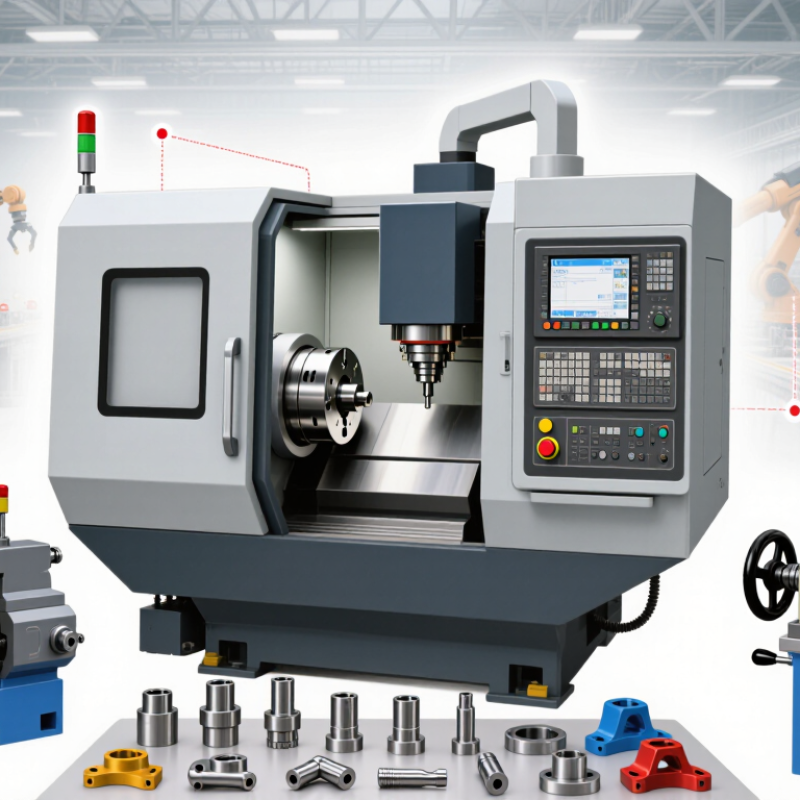
A mill lathe combines turning with milling, drilling, and sometimes tapping in one setup. The workpiece rotates for turning, while driven tools cut features such as slots, flats, and cross-holes. This reduces repeated clamping and helps keep features aligned. A small shop may use a manual combination machine for simple repairs; production floors often rely on CNC mill-turn centers for complex parts. Capabilities vary, so “mill lathe” is not one fixed machine type.
Modern machining increasingly links machine tools with automation. The International Federation of Robotics reported 4,281,585 industrial robots operating in factories worldwide in 2023, up 10% from 2022, in its World Robotics 2024 report. That figure describes industrial robots broadly, not mill lathes specifically. Still, it reflects the wider move toward connected production, where CNC machines can work alongside robots and inspection systems. The payoff depends on programming, tooling, and part volume. Setup mistakes still happen.
Tip: Check spindle speed, tool capacity, travel, and workholding before choosing a machine. For a real job, test whether one setup can reach every feature without tool interference. Record cycle time and scrap during a trial run. A machine that looks versatile on paper may be awkward to operate. That deserves a second look.
What Are the Top Mill Lathe Types in 2026? — Mill Lathe Basics and Their Role in Modern Machining
| Machine Type | How It Works | Typical Axes | Best-Suited Work | Main Advantages | Key Considerations |
|---|---|---|---|---|---|
| Manual Engine Lathe | A rotating workpiece is cut by a tool controlled by the operator using handwheels and mechanical feeds. | Two principal linear axes: longitudinal and cross-slide | Shafts, bushings, simple tapers, repair work, and one-off parts | Direct operator control; practical for short runs, training, and maintenance work | Production rate and repeatability depend heavily on operator skill; complex profiles take more setup and labor. |
| CNC Turning Center | A computer-controlled cutting tool machines a workpiece held in a chuck or collet as it rotates. | Commonly 2 axes; some machines add a live-tool axis or a secondary spindle | Round components such as pins, housings, threaded parts, and stepped shafts | Repeatable production and efficient turning; optional live tooling can perform some milling operations | Standard configurations are primarily designed for rotational parts; available features vary by machine. |
| Vertical Milling Machine | A vertically oriented spindle rotates the cutting tool while the workpiece is clamped to a table. | Typically 3 linear axes; additional rotary axes may be fitted | Flat faces, slots, pockets, holes, and prismatic components | Good access to the work area; suitable for general-purpose milling and a broad range of setups | Workpiece size, rigidity, and available travel limit the parts that can be machined in one setup. |
| Horizontal Milling Machine | A horizontally oriented spindle carries the cutter; some configurations use an arbor supported at the far end. | Typically 3 linear axes; rotary tables or other axes are optional | Long slots, heavier cuts, and machining multiple surfaces with suitable fixtures | Can provide strong support for certain cutters and efficient material removal on suitable work | Tooling and setup can be more specialized than for a general-purpose vertical mill. |
| CNC Mill-Turn Machine | Combines turning with powered milling tools; the workpiece may rotate in a spindle or be indexed to a controlled position. | Often 3–5 or more controlled axes, depending on configuration | Complex parts that need both turned features and milled flats, holes, or cross-features | Can reduce part transfers and setup changes by combining operations in one machine | Programming, workholding, and process planning are more involved; capability depends on the machine’s axis and tooling configuration. |
| Mill-Lathe Combination Machine | A compact machine provides basic turning and milling functions, usually with shared or repositionable workholding. | Configuration-dependent; commonly offers basic turning and milling axes | Small parts, prototypes, hobby or educational projects, and light-duty workshop jobs | Combines two functions in a limited floor space and can suit low-volume work | Capacity, rigidity, and simultaneous machining capability are generally more limited than on dedicated industrial machines. |
Selection note: Axis counts and available features vary by machine configuration. Choose based on part geometry, material, production volume, required accuracy, workholding, and the operations that must be completed.
Related Posts
-
Top 10 Mill Lathe Machines for Global Buyers in 2026?
-
Top 10 CNC Machine Tools Every Buyer Should Consider?
-
How to Choose the Best Milling Equipment for Your Business in the 2025 Global Market
-
Global Excellence in Manufacturing with Chinese Quality the Best Coordinate Measuring Machine
-
Top Strategies for Selecting the Best Measuring Equipment for Your Business
-

2026 Top Machine Tools Trends You Need to Know?