How to Buy a Used Lathe for Your Business?

Buying a Used Lathe can help your business add capacity without the cost of a new machine. But a low asking price tells only part of the story. The lathe must suit the work you actually do, from the materials and part sizes to the tolerances your customers expect. A machine that looks solid in photographs may still have worn ways, excessive spindle play, or controls your operators cannot use confidently. Small details matter.

A careful buying process starts with your production needs and a realistic budget. Then check the machine’s age, specifications, maintenance records, available tooling, and service history. If possible, inspect it under power. Watch the spindle run, test the feed and speed controls, and examine a sample cut for chatter or poor finish. Bring a qualified machinist or technician when you lack the experience to judge wear. Their time may prevent an expensive mistake.

Also account for rigging, transport, installation, electrical requirements, repairs, and downtime. These costs are easy to underestimate. Ask the seller direct questions, document the answers, and confirm what accessories are included. No inspection can guarantee a trouble-free machine, and some wear may be difficult to spot. That is worth remembering. The sections ahead explain how to assess condition, compare prices, and decide whether a particular Used Lathe is a practical fit for your business.
How to Buy a Used Lathe for Your Business?

Define Your Business Needs and Required Lathe Specifications

Before comparing used lathes, write down the work your shop actually handles. Record the material, maximum diameter, part length, required tolerance, and expected weekly hours. A steel shaft needs different capacity from small brass fittings. Measure your largest real part, not an imagined future job. Buyers sometimes overestimate their needs and pay for capacity that takes up valuable floor space. I could be wrong about future demand, so leave room to reassess.

Match those jobs to the machine’s swing over the bed, distance between centers, spindle bore, and speed range. Check that the spindle can hold your stock and that available speeds suit your materials and cutting tools. Consider motor power, electrical supply, coolant needs, and the space required for safe loading. A generous specification sheet is not proof of good condition. Have a qualified machinist inspect spindle play, bed wear, and feed operation; uneven wear near the headstock can affect accuracy. Test the machine under power when possible, using a cut similar to your normal work.

Tips: Bring a drawing of a typical part and a short list of must-have specifications. Keep one item flexible, such as maximum length, if the right machine is otherwise a fit.

Set a Budget for Purchase, Repairs, and Installation

Set a firm ceiling before inspecting machines, but separate the lathe price from the cost of making it productive. Include freight, rigging, electrical work, foundation changes, tooling, and operator training. Ask for written quotes; a low auction price can grow quickly once a crane and electrician are involved. Keep a 20–30% contingency for uncertain repairs and installation. That is a planning allowance, not a guaranteed industry benchmark.

Budget repairs from evidence, not optimism. Request maintenance records and check spindle runout, bearing noise, lead screws, ways, and control functions under power. Price replacement parts and specialist labor before committing. The U.S. Bureau of Labor Statistics reported a May 2023 median annual wage of $50,840 for machinists. That is a useful labor-cost reference, not a machine-repair rate; service calls may also include travel, diagnostics, and shop overhead. Get local estimates.

Installation details matter. Confirm the machine’s weight, door clearance, floor capacity, voltage, and leveling requirements with qualified contractors. Include alignment and a test cut in the commissioning budget. A machine that powers on may still cut inaccurately. Leave funds for surprises. Even a careful inspection can miss wear hidden behind covers, and skipping that risk allowance is an easy mistake to regret.

Evaluate Lathe Types, Capacity, Age, and Condition

A used lathe should match the work your business actually receives, not just the jobs you hope to win. An engine lathe suits varied repair and turning tasks, while a CNC lathe may fit repeat production better. Check swing over the bed and distance between centers against your largest regular parts. Measure twice. A long workpiece may fit between centers but still exceed the machine’s practical cutting capacity.

Age is only a clue, not a verdict. A well-maintained older machine can outperform a newer one that has been neglected. Ask for maintenance records, then inspect the bedways near the headstock, where repeated work often leaves visible wear. Check spindle play and, if possible, measure runout with an indicator. Uneven readings deserve questions. Test every feed and speed, and listen for grinding or knocking under load. A brief demonstration is useful, but it may not reveal problems after the machine warms up.

Look closely at the chuck, tool post, tailstock, and included tooling; replacing missing pieces can quickly change the real purchase cost. Confirm the electrical supply and floor space before arranging delivery. I would also budget for leveling, setup, and likely repairs. It is easy to underestimate these. One imperfect detail is normal on a used machine; several unexplained faults should change your offer or make you walk away.

Inspect the Machine and Verify Its Operating Performance

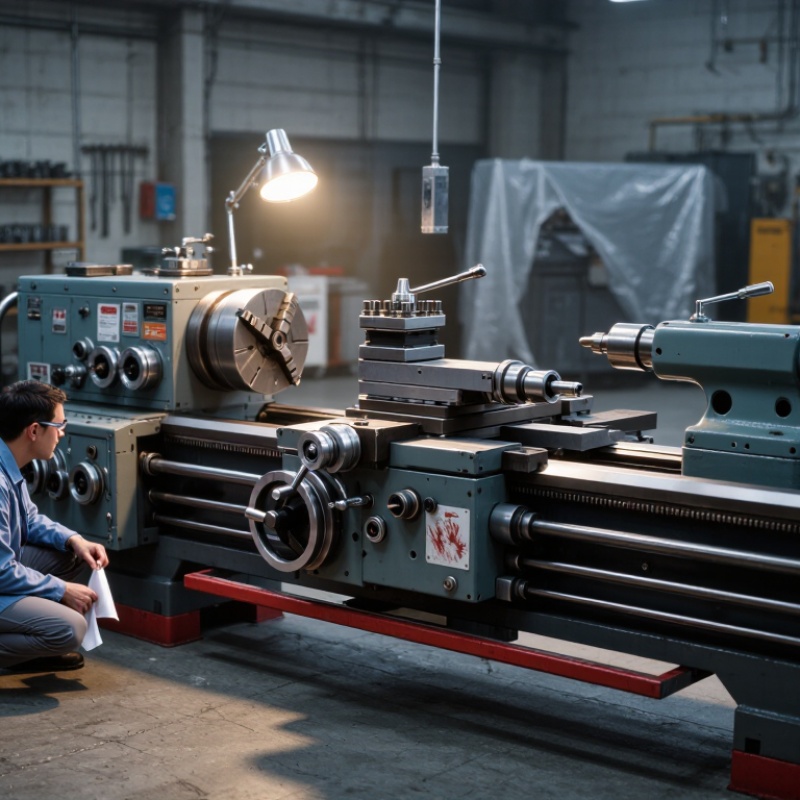
Before buying a used lathe, inspect it cold and unplugged. Check the bed for scoring, chipped edges, and uneven wear near the chuck. Turn the spindle by hand; feel for rough spots or excess play. Then run the machine through its speed range. Listen for knocking, watch for vibration, and test every feed and gear. A smooth sound is encouraging, but not proof.

Measure spindle runout with a dial indicator, and compare it with the tolerance required for your work. Make a test cut in a straight bar, then check diameter consistency and surface finish at several points. Verify that the chuck holds securely and that guards, emergency stops, and brakes function. The U.S. Bureau of Labor Statistics reported 2.8 recordable nonfatal injury and illness cases per 100 full-time manufacturing workers in 2023. That figure is a useful reminder: safety controls deserve the same attention as accuracy. A fresh coat of paint proves very little.

Tips: Bring a dial indicator, test bar, and flashlight. Ask to see the lathe run for at least 15 minutes, then inspect it again while warm. Record readings and unusual noises. If the seller cannot demonstrate a cut, pause before committing. I have seen buyers focus on the price and overlook a worn bed; it is an easy mistake to regret.

Review the Sale Terms and Plan Delivery and Setup

Before paying for a used lathe, get the sale terms in writing. Ask the seller to list the machine, included tooling, and any known faults. “Running condition” is vague. Request a test under power, if practical, and note what you observe: unusual vibration, noisy bearings, or a worn chuck. Record whether the sale includes manuals, guards, and accessories. Get it in writing.

Check who is responsible for loading, transport, and unloading. Confirm the payment schedule, deposit conditions, and what happens if the lathe differs from its stated condition. A low price can become costly when a chuck, steady rest, or electrical component is missing. Small details matter. If a term feels unclear, pause and ask for a plain explanation; a rushed agreement is hard to fix later.

Measure the route into your workshop, including doorways, floor capacity, and turning space for the delivery equipment. Confirm the lathe’s weight and dimensions before arranging a truck or lift. Ask whether the seller will disconnect it, and whether a qualified rigger is needed. Plan for a level, stable foundation and suitable power before arrival. I have seen setup plans overlook cable reach; it is an easy detail to miss. Keep space for alignment checks and safe access to controls.

How to Buy a Used Lathe for Your Business? - Review the Sale Terms and Plan Delivery and Setup

Stage Item to Review What to Verify Record or Acceptance Criteria Planning Note
Before Purchase Machine identity and specifications Check the machine’s model and serial number, swing, distance between centers, spindle bore, speed range, and included accessories against the seller’s listing and available documentation. Save a dated specification sheet, clear photos of the nameplate, and an inventory of included tooling and accessories. Confirm that the machine’s capacity suits the largest workpiece and operations the business expects to handle.
Before Purchase Condition and operating test When possible, inspect the lathe under power. Test spindle speeds, feed and threading functions, controls, lubrication, and emergency-stop operation. Check for unusual noise, vibration, leaks, visible damage, and excessive play. Document test results and defects in writing; request permission to inspect the machine before payment or removal. A test run does not replace a qualified inspection. Arrange one if the machine’s condition or repair history is uncertain.
Sale Terms Written agreement and payment Confirm the total price, deposit, payment method, payment due dates, taxes or other charges, and the point at which ownership transfers. Use a signed bill of sale that identifies the machine by serial number and lists all included items and agreed conditions. Clarify whether the sale is “as is” and whether any inspection, demonstration, or written warranty is included.
Sale Terms Liens, ownership, and removal deadline Ask the seller to confirm in writing that they have authority to sell the machine and disclose any lien or ownership claim. Agree on the removal deadline and site-access rules. Keep the seller’s written ownership confirmation, sale documents, and any lien-release documentation that applies. Do not assume the buyer can enter the site or arrange removal without the seller’s approval and any required site procedures.
Delivery Planning Machine weight and transport requirements Obtain the actual machine weight and dimensions from its documentation or nameplate. Tell the carrier about loading access, route restrictions, and required lifting equipment. Get a written transport and rigging quote based on the machine’s verified weight, dimensions, pickup location, and delivery conditions. Do not estimate lifting capacity from appearance. The rigging provider should confirm the equipment and method for the specific load.
Delivery Planning Pickup, loading, and transit responsibility Agree who disconnects, prepares, loads, secures, transports, unloads, and places the lathe. Confirm responsibility for damage and insurance during each stage. List responsibilities, dates, site contacts, and insurance arrangements in the purchase or delivery documents. Clarify whether the seller’s facility has a suitable loading dock or lifting equipment; do not assume loading is included.
Setup Planning Workshop space and floor Measure the machine and allow working access for the operator, workpieces, maintenance, and material handling. Check the floor and installation location with a qualified professional if load capacity is uncertain. Keep a layout drawing with machine dimensions, access clearances, delivery path, and the approved installation position. Check doorways, corridors, turning space, floor transitions, and overhead obstructions before scheduling delivery.
Setup Planning Electrical supply Read the machine nameplate for voltage, phase, frequency, and full-load current. Have a qualified electrician compare these requirements with the available supply and applicable local electrical rules. Obtain confirmation that the supply, disconnect, wiring, and any required protection are suitable before connecting the machine. Industrial lathes may require three-phase power, but requirements vary by machine; never select a supply based only on the machine’s size.
Setup Planning Leveling, anchoring, and commissioning Follow the machine maker’s installation instructions for leveling, anchoring, lubrication, and initial checks. Verify guards and safety devices before production use. Record installation checks and obtain a qualified technician’s sign-off where required by the machine, insurer, or local rules. Plan for appropriate leveling equipment, installation tools, and any commissioning service before the machine arrives.
Final Check Delivery inspection and records Inspect the machine and accessories on arrival before signing delivery paperwork. Photograph visible damage and note shortages or damage on the delivery receipt. Keep the bill of sale, inspection notes, delivery documents, electrical records, service history, and photos together in the business’s equipment file. Report transport damage promptly according to the carrier’s documentation and claims process.

Planning checklist only. Verify machine-specific requirements, transport arrangements, and applicable workplace and electrical rules before purchase and installation.